The Torch at 740 Eighth Avenue: A Supertall Built Around Holdouts
The Torch at 740 Eighth Avenue shows how Broadway theater air rights, holdout buildings, and a planned drop ride can reshape one Times Square block.
The strange thing about The Torch is not only that it plans to put a thrill ride in the sky.
The stranger thing is the ground.
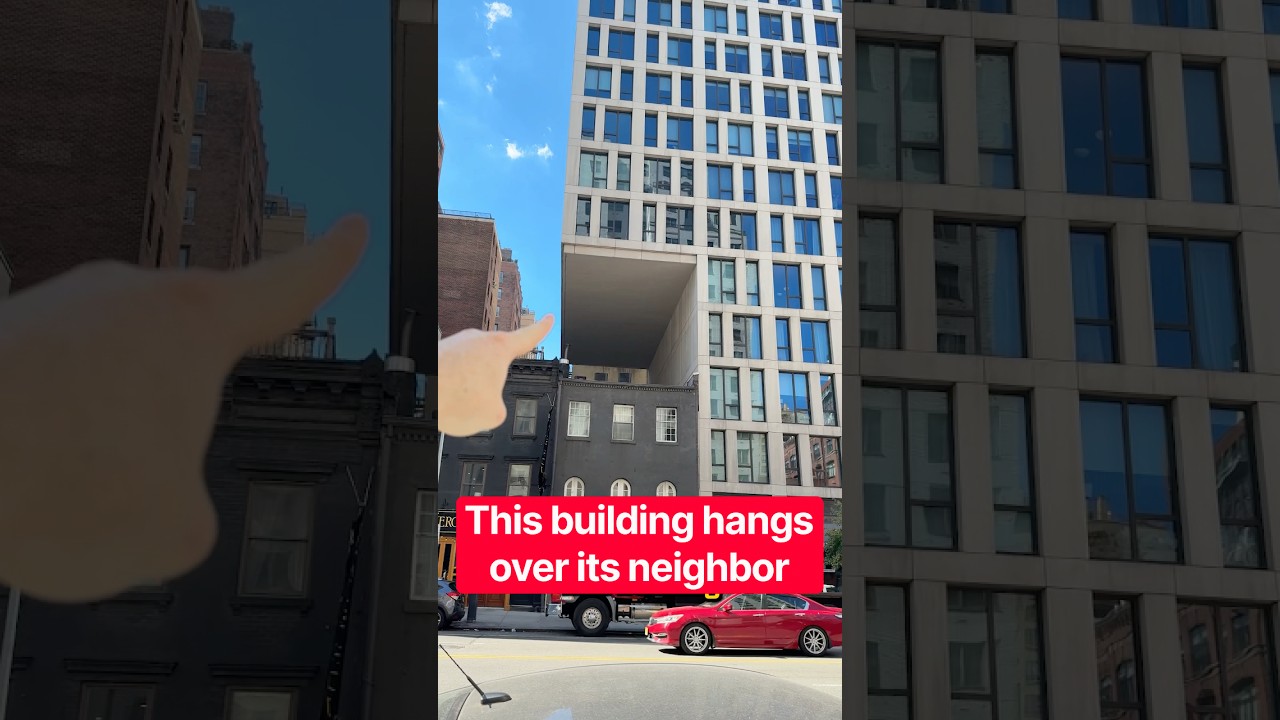
At 740 Eighth Avenue, Extell is building a planned 1,067-foot hotel and observation tower on a Times Square block that did not become a clean rectangle. Three low-rise holdout buildings remain along the Eighth Avenue frontage, so the new tower rises around them rather than through them. From the sidewalk, that makes the project feel less like a single erased block and more like a negotiation frozen in concrete and steel.
That is New York development in its purest form: the tower is not just what the architect drew. It is what the zoning allowed, what the developer assembled, what owners refused to sell, what air rights could be bought, and what engineers could make stand.
Where it is
The Torch, 740 Eighth Avenue, New York, NY 10036
The backstory starts with Broadway theaters.
Theater buildings are some of the most valuable properties in Manhattan, but many of them are landmarked or otherwise tightly protected. That protection matters. It keeps Broadway from becoming just another redevelopment district where historic auditoriums are demolished and replaced with the highest possible rent. But it also creates a financial tension. A theater may sit on land whose unused development potential is worth a fortune, while the owner cannot simply build a profitable tower on top of the stage.
In 1998, the city created the Theater Subdistrict Fund as part of a broader effort to preserve Midtown theaters. The key idea was not new to New York: unused development rights could be transferred. But the theater district version was unusually flexible. Instead of limiting transfers mostly to adjacent parcels, the rules allowed listed theaters to send air rights to qualifying sites elsewhere within the subdistrict. A contribution tied to those transfers also supports theater-related programs through the fund.
That turned empty air above old theaters into a financial instrument.
The Torch is one result of that system. The Real Deal reported that Extell paid $31 million for two properties at 738 and 740 Eighth Avenue and $51 million for development rights in 2021, advancing a site the company had been piecing together for years. Forbes reported that the Shubert Organization sold air rights connected to the Imperial Theatre for more than $51 million, then described as a record-breaking deal in the area.
The logic is easy to miss if you only look upward.
Times Square is a place where every surface is already monetized: signs, storefronts, hotel rooms, theater marquees, observation decks, pedestrian flows, even attention itself. Air rights fit perfectly into that economy because they make vertical capacity tradable. A theater keeps its auditorium. A developer gets height somewhere else. The district keeps a version of its historic fabric while still absorbing skyscraper economics.
Then the holdouts complicate the clean diagram.
Most towers want simple geometry at the base. Clean lots make clean load paths. Foundations, columns, elevators, service cores, egress stairs, truck access, hotel back-of-house space, and retail all become easier when the ground is fully controlled. But The Torch has to work around existing buildings that remain in place. Recent construction coverage from Field Condition describes the project as wrapping around three low-rise structures at the base before tapering upward into the columnar tower.
That makes the building a structural and logistical puzzle before it ever becomes a skyline object.
The planned program is equally Times Square. New York YIMBY has reported that the 52-story tower, designed by ODA and developed by Extell, is planned to include an 825-room hotel, public outdoor observation areas, and an Intamin-designed drop ride using transparent tubes in the tower's stem. Earlier descriptions put the ride around 260 feet; more recent YIMBY coverage describes 300-foot-tall tubes and a 90-second experience.
In another neighborhood, that might seem like a gimmick.
In Times Square, it is almost logical.
The district has always mixed architecture with spectacle. Broadway theaters sell performance. Billboards sell scale. Observation decks sell the city back to itself. A hotel tower with a ride at the top is not a break from Times Square's identity so much as an escalation of it. The building is not only trying to house visitors. It is trying to become an attraction.
That ambition is also why the tower matters beyond novelty.
If completed as planned, The Torch would be one of the rare supertalls directly associated with the Times Square/Theater District core, pushing a form more commonly linked with Billionaires' Row, Hudson Yards, or the World Trade Center into a neighborhood defined by crowds, signage, hotels, and theaters. It would turn the area's vertical economy into an object visible from far outside the district.
The construction story has already been uneven. Coverage in 2024 reported a pause at the site. By mid-2025, work had resumed, and by March 2026 Field Condition reported the superstructure had surpassed the 20th floor. That matters because The Torch is still an active project, not a finished monument. Its final height, opening date, and operating details should be treated as plans until the building is complete.
But even unfinished, the project already tells the story.
Broadway's theaters could not all build upward, so the district invented a way to move height sideways. Extell assembled a site but did not get every piece, so the tower adapted. Times Square already monetized attention, so the building added an observation deck and a drop ride. The result is not a clean skyscraper in the classical sense. It is a stack of bargains.
That may be what makes it so New York.
The Torch is not rising from a blank slate. It is rising from a block where ownership, preservation, entertainment, zoning, and spectacle all refused to stay in their lanes.
Sources
- NYC Department of City Planning, Theater Subdistrict Fund Text Amendment
- NYC Zoning Resolution, Section 81-744: Transfer of development rights from listed theaters
- The Real Deal, Extell's Times Square megaproject advances with $82M deal
- Forbes, Broadway Theater Owner Floating On Air After Record-Breaking Deal
- New York YIMBY, The Torch Resumes Construction at 740 Eighth Avenue
- Field Condition, Construction Update: The Torch at 740 Eighth Avenue
Everyday Science, in your inbox.
Get new stories about the engineering, technology, architecture, and history around us.