The Municipal Building That Hid a Subway, a Street, and a Rooftop View
The David N. Dinkins Municipal Building was designed as a civic machine, combining city offices, streets, subway access, and a newly opened public rooftop view.
The David N. Dinkins Municipal Building is not just a building. It is a piece of city government turned into stone, tile, steel, and circulation.
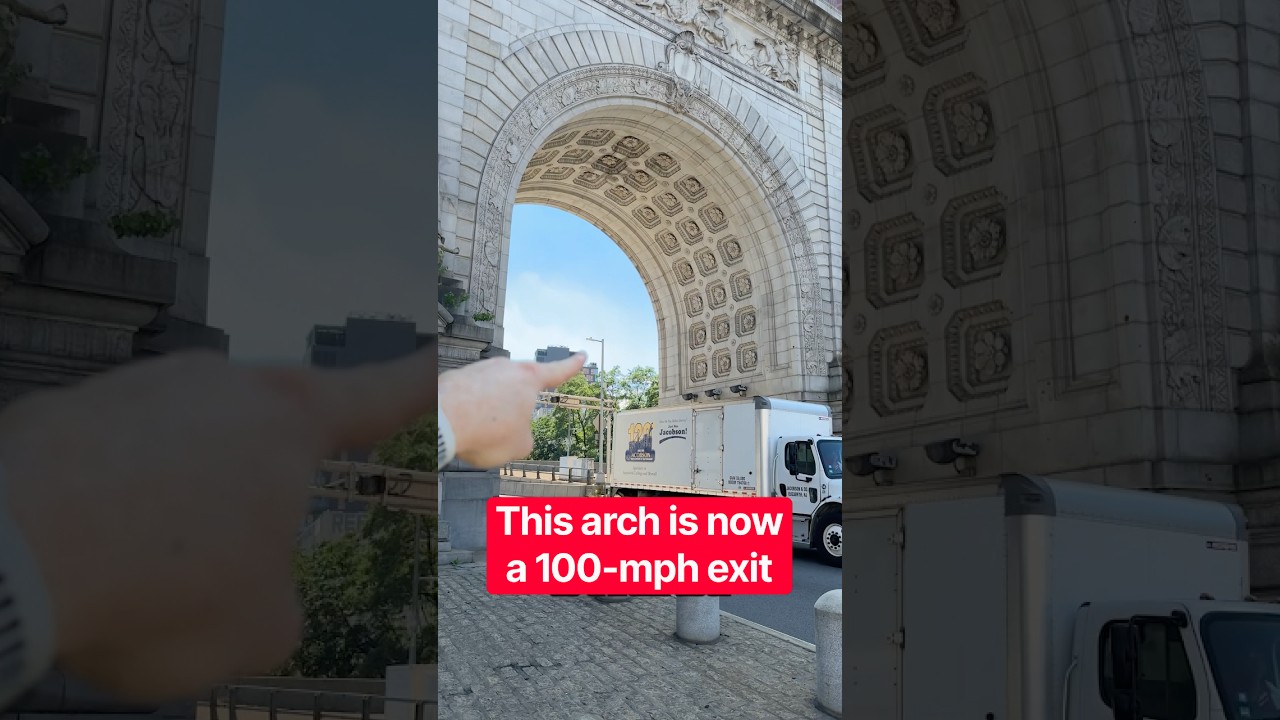
That sounds abstract until you stand under its giant arch. The building does not merely sit beside Lower Manhattan's streets. It absorbed them. It was designed around traffic, trolleys, subway riders, city agencies, civic symbolism, and the messy fact that New York had suddenly become much larger than its old City Hall could handle.
Where it is
1 Centre Street, New York, NY 10007
The problem began in 1898, when New York consolidated Manhattan, Brooklyn, Queens, the Bronx, and Staten Island into one city. The new government was enormous by the standards of the old municipal core. City agencies were scattered through rented offices, and City Hall, elegant as it was, could not simply expand enough to run the five-borough city.
The city needed a headquarters for bureaucracy at metropolitan scale.
The site was difficult from the start. It sat near the Brooklyn Bridge, one of the great gateways into Manhattan, at a place already tangled with streets, elevated lines, trolley movement, and future subway infrastructure. A normal office block would not do. The building had to be architecture, traffic engineering, transit planning, and civic theater at the same time.
After several failed attempts, the city held a competition that treated the transit problem as part of the design problem. McKim, Mead & White won with a plan that wrapped offices around an enormous central arch and incorporated subway access into the building's base.
That was radical for New York.
The Municipal Building became the first building in the city to include a subway station within its base. Under the loggias, grand stairs led riders down to the Chambers Street station. The architecture did not treat the subway as an afterthought hidden in a hole. It gave the entrance a ceremonial quality, with Guastavino tile vaulting helping make the descent feel more like entering a civic hall than disappearing underground.
That mattered because early subway culture still had to persuade people that going underground was safe, modern, and respectable. Tile, arches, light, and scale were not decoration alone. They were psychology.
The building also handled a street.
New Chambers Street once passed through the central arch. The arch was large enough to function as an urban passage, not simply a symbolic opening. Later street changes altered that role, but the geometry still tells the story: this was a building designed for a city in motion.
Above all that movement, the tower rises into pure allegory.
At the top is Civic Fame, a gilded copper statue designed by Adolph A. Weinman. The figure stands roughly 25 feet tall and carries symbols of New York's government and borough identity. For more than a century, she had one of the best views in the city and almost no public company.
That changed in 2026.
New York City began opening the Municipal Building's cupola area to free public tours, giving visitors access to a rooftop vantage point that had long been off-limits. The detail feels almost too perfect for the building's story. A structure built to make government visible finally gives the public a way to climb closer to the symbol on top of it.
The view is not the only reason to care.
The Municipal Building is one of the great examples of the City Beautiful movement in New York, the belief that civic architecture could express order, dignity, and public ambition. It is also one of the clearest reminders that beauty and bureaucracy are not opposites. The city needed offices, records, elevators, subway connections, and rentable efficiency. It also wanted grandeur.
The result is a building that can feel almost excessive today. But its excess was part of the message. Consolidated New York was not a loose collection of boroughs anymore. It was a capital of itself, and it needed architecture large enough to say so.
That is why the building still works as a story.
At the bottom, people moved through streets and subways. In the middle, thousands of city workers processed the machinery of government. At the top, Civic Fame turned the whole thing into myth.
For a century, the secret was not that the building had hidden spaces.
The secret was that the whole building was a hidden diagram of how New York learned to govern itself.
Sources
- NYC Landmarks Preservation Commission, Municipal Building designation report
- 6sqft, Manhattan Municipal Building to open rooftop for free tours
- Secret NYC, Free tours at the David N. Dinkins Manhattan Municipal Building
- National Park Service, Manhattan Municipal Building historic documentation
- Guastavino Alliance, Guastavino tile in New York civic architecture
Everyday Science, in your inbox.
Get new stories about the engineering, technology, architecture, and history around us.