350 Park Avenue: Unbuilding a Tower for Citadel's Supertall
350 Park Avenue is being cleared for a planned 1,414-foot office tower shaped by air rights, all-electric systems, trading floors, and Midtown's view economy.
At 350 Park Avenue, the first skyscraper is going down so the next one can go up.
That sounds obvious until you watch demolition in Midtown. This is not a remote industrial site where a tower can simply be imploded and swept away. It is Park Avenue, surrounded by offices, traffic, landmark buildings, utilities, subway infrastructure, pedestrians, and neighbors whose windows sit close enough to make every falling object a problem.
So the old buildings are being unbuilt carefully.
Where it is
350 Park Avenue, New York, NY 10022
As of July 2026, demolition is underway for the future 350 Park Avenue, a planned supertall office tower tied to Ken Griffin's Citadel and Citadel Securities, Vornado Realty Trust, and Rudin. New York YIMBY reported the planned tower at about 1,414 feet, designed by Foster + Partners, with roughly 1.8 million square feet of Class A office space and Citadel-related companies as anchor tenants.
The demolition is only the first visible act in a much larger exchange.
The project replaces multiple existing buildings on the block, including the current 350 Park Avenue. In a less dense city, demolition might be treated as a prelude. Here, it is a major construction project in its own right. Structures have to be stripped, cut, braced, sorted, lowered, and removed behind netting and scaffolding while Midtown keeps functioning around them.
The reason for all that effort is height.
The new tower's scale depends in part on development rights assembled from nearby landmarks and institutions, including air rights associated with St. Patrick's Cathedral and St. Bartholomew's Church. This is one of the strangest features of Midtown East real estate: churches and landmarks can hold unused development potential above themselves, and a new office tower can buy that unused sky and move it onto a different site.
The money does not buy air in the poetic sense. It buys legal capacity.
That capacity matters because 350 Park Avenue is not being designed like a narrow luxury apartment tower. It is an office building for one of the most demanding kinds of tenants in finance. Trading floors are closer to mission-critical infrastructure than ordinary corporate cubicles. They need high ceilings, heavy power, redundant systems, cooling, data capacity, and wide, flexible floor plates that can support dense technology and fast communication.
That is why the floor count can sound surprisingly low for the height.
A residential supertall might stack many relatively thin apartment floors into the sky. A headquarters-scale office tower uses taller floor-to-floor heights, larger mechanical zones, and more infrastructure. The vertical space is not just for people. It is for air, power, cooling, structure, elevators, and equipment.
The new 350 Park Avenue is also planned as an all-electric building. That detail belongs to a broader shift in New York development, where major new buildings are being pushed away from on-site fossil-fuel combustion. Electrification changes the machinery of the tower. The building still needs heating, cooling, ventilation, hot water, emergency systems, and huge electrical capacity, but the energy strategy moves through a different set of equipment and assumptions.
In a tower like this, machinery is not backstage. It is one of the main characters.
The design renderings show a stepped glass tower with terraces and a major public concourse at street level. Foster + Partners' scheme uses stacked volumes and rounded corners, with the most open face oriented toward Park Avenue. That openness is part architecture and part product. Park Avenue offices are sold on light, prestige, arrival, and views.
But views in New York are never neutral.
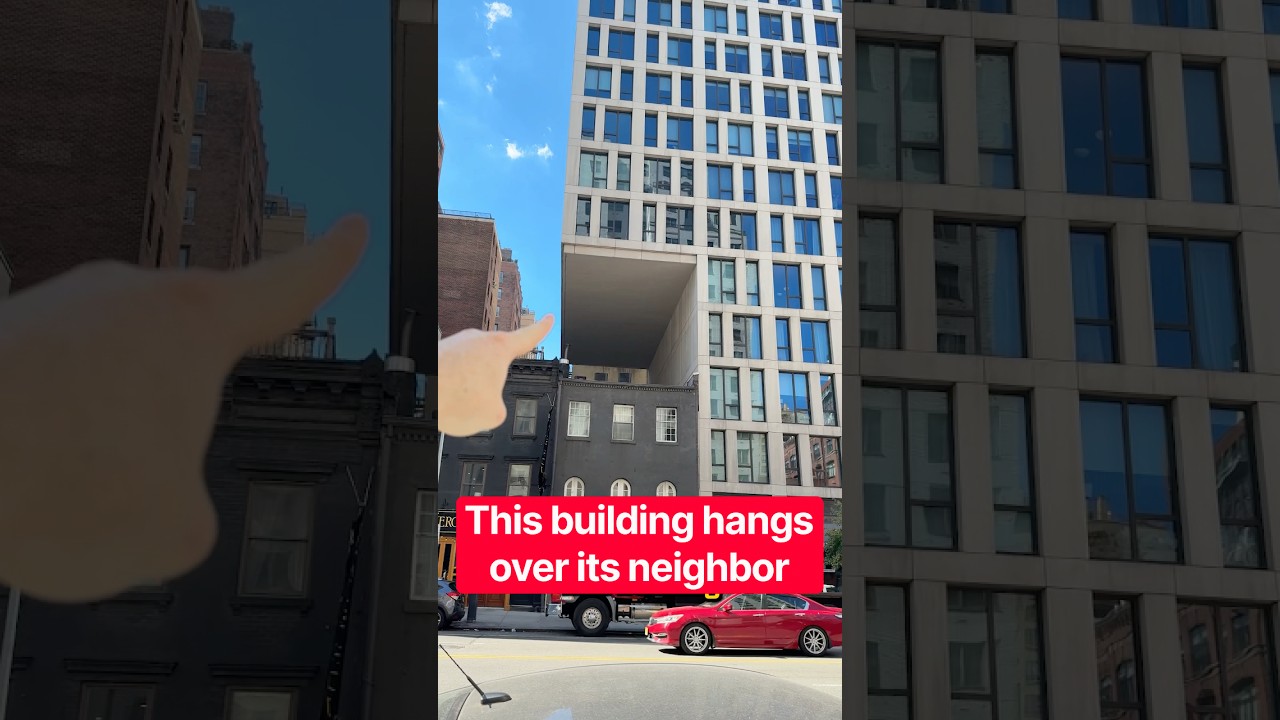
The script's line about windows on the property line being sealed forever gets at a real rule of the city: if you build directly on a lot line, you cannot depend on that side remaining open. A neighboring building may rise against it. Windows facing a property line can become lot-line windows, vulnerable to being blocked when the adjacent site is developed. In Manhattan, the view often belongs to whoever can legally build last.
That makes 350 Park Avenue a very New York kind of tower.
It is not just replacing an old office building with a taller one. It is converting church air rights, landmark adjacency, finance-sector demands, demolition logistics, all-electric systems, public-realm obligations, and Park Avenue prestige into a single vertical headquarters.
The blue netting around the demolition site is temporary.
The real story is the city behind it: a place where even empty sky has an owner, and even a view can be taken apart and rebuilt.
Sources
- New York YIMBY, Demolition Underway for 1,414-Foot Supertall at 350 Park Avenue
- 6sqft, 350 Park Avenue gets City Council approval
- The Real Deal, Vornado, Rudin reveal larger 350 Park Avenue project
- The Real Deal, St. Bartholomew's air rights for 350 Park Avenue
- PincusCo, St. Patrick's Cathedral air rights for Midtown East tower
Everyday Science, in your inbox.
Get new stories about the engineering, technology, architecture, and history around us.